
The basement is the paradox of modern housing. It offers the most square footage for the least amount of money, yet it is often the least inviting room in the house. It suffers from a fundamental architectural flaw: it is buried underground.
Whether you are designing a home theater, a guest suite, or a playroom, the primary enemy in a basement renovation is “The Gloom”—that shadowy, cool, cave-like atmosphere that persists even when the lights are on.
Many homeowners attempt to fix this by painting the walls “Stark White,” assuming white equals bright. In a basement, this is often a fatal design error. Without natural sunlight to warm it up, pure white paint turns gray, dingy, and sterile, making the space feel more like a hospital storage room than a cozy den.
To truly brighten a basement, you need to master Light Reflectance Value (LRV) and Undertone Physics. This guide will walk you through the exact colors, lighting strategies, and finish techniques to simulate sunlight where it doesn’t exist.

Part I: The Physics of Basement Light
Before you buy a sample pot, you must understand why light behaves differently below grade than it does in your living room.

Pro Grade Paint Roller Kit, Brush & Roller for Professionals & Homeowners
Perfect for smooth finishes on your interior walls. Ideal for home improvement enthusiasts!
Buy Now on Amazon1. The “Gray Shadow” Phenomenon
In an upstairs bedroom, sunlight bounces around the room, picking up warmth from the sun (yellow/orange spectrum). In a basement, your light source is usually artificial (LEDs) or weak, filtered ambient light.
- The Problem: Low-light environments naturally cast a blue-grey shadow.
- The Consequence: If you paint a wall a “Cool Gray” or a “Pure White” (which has blue undertones), the natural shadows of the basement will amplify that blue/gray. The result is a muddy, concrete-like color that feels cold and depressing.
- The Solution: You must overcorrect with warmth. You need paint colors with yellow, red, or orange undertones to neutralize the basement’s natural blue shadows.

2. Understanding LRV (Light Reflectance Value)
LRV is a measurement from 0 (Black) to 100 (White) that tells you how much light a paint color reflects.
- The Sweet Spot: For a basement, you generally want an LRV between 60 and 85.
- The Trap: If you go too high (LRV 90+), the walls can feel stark and glare-y under electric lights. If you go too low (LRV <50), you will need massive amounts of wattage to keep the room from feeling like a cave.

Part II: The “Sunshine” Whites (Warm Whites)
The most requested look for modern basements is “Clean and Bright.” To achieve this without the “sterile hospital” vibe, you must avoid stark whites (like Sherwin Williams Extra White) and choose Off-Whites with a creamy base.

1. Benjamin Moore White Dove (OC-17)
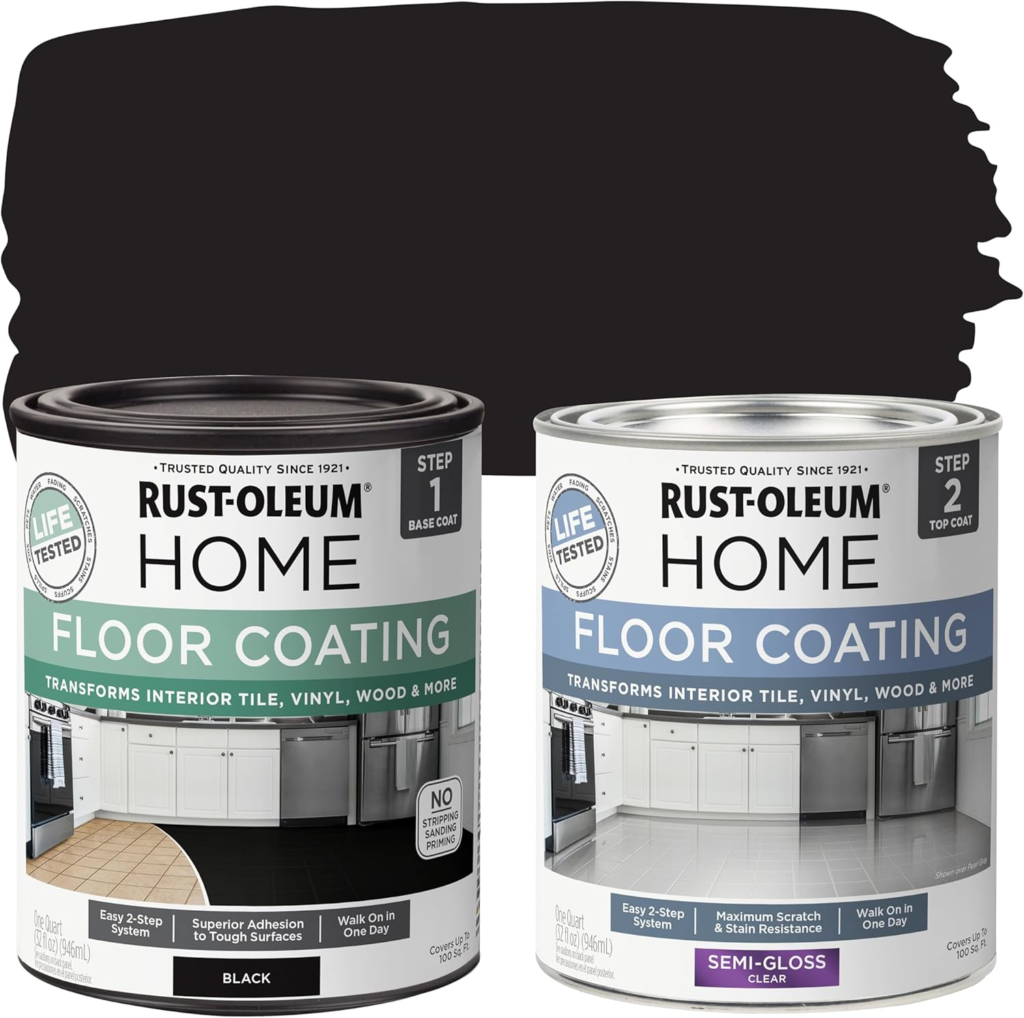
Rust-Oleum 367605 Home Interior Floor Coating Kit, Semi-Gloss Black
Ideal for updating outdated flooring at a fraction of the cost of replacement and adheres without stripping, sanding or priming.
Buy Now on Amazon- LRV: 85
- The Vibe: This is the gold standard for basements. It is a soft, warm white that contains a tiny drop of grey and a drop of yellow.
- Why it works: It is bright enough to bounce light into dark corners, but the soft undertone prevents it from looking harsh. It mimics the look of white plaster in an old farmhouse—velvety and approachable.
- Best Pairing: Works beautifully with light oak luxury vinyl plank (LVP) flooring.

2. Sherwin Williams Greek Villa (SW 7551)
- LRV: 84
- The Vibe: A sunny, Mediterranean white.
- Why it works: Greek Villa has a stronger yellow undertone than White Dove. In a bright living room, it might look creamy. In a dark basement, that yellow pigment gets “eaten” by the shadows, leaving you with a wall that looks like a pure, happy white.
- Best Pairing: Excellent for basements with absolutely no windows.
3. Benjamin Moore Swiss Coffee (OC-45)
- LRV: 84
- The Vibe: Sophisticated and organic.
- Why it works: A favorite of high-end designers like Studio McGee. It has a slightly stronger warmth than White Dove. It creates a “glow” when hit with recessed lighting, making the walls feel like they are radiating warmth.
Part III: The “Illuminators” (Yellows and Creams)
If your basement is particularly dark, or if you are designing a space that needs high energy (like a playroom or laundry room), you may want to graduate from white to cream.
4. Sherwin Williams Dover White (SW 6385)
- LRV: 83
- The Vibe: A cozy, vintage cream.
- Why it works: This color is unabashedly warm. It essentially acts as a “sunlight simulator.” If you have small hopper windows that let in cold, bluish northern light, Dover White neutralizes that chill instantly.
5. Farrow & Ball Tallow (No. 203)
- The Vibe: A pale, reflective cream with a hint of pink/yellow.
- Why it works: This paint is famous for its reaction to artificial light. It takes the harshness out of LED bulbs and reflects a flattering, warm glow back onto the room’s occupants.
Part IV: The “Atmospheric” Palette (Blues and Greens)
Can you use color in a basement? Yes, but you must be careful. Dark colors can make a basement feel like a “man cave” or theater (which is fine if that’s the goal), but if the goal is brightness, stick to “Atmospheric” colors—colors that mimic the sky.

6. Sherwin Williams Sea Salt (SW 6204)
- LRV: 63
- The Vibe: A chameleon color that shifts between green, blue, and gray.
- Why it works: It brings an organic, outdoor feel to a subterranean space. It tricks the brain into associating the room with fresh air and water, countering the “buried” feeling of a basement.
- CRITICAL WARNING: You must use 4000K (daylight) bulbs with this color. If you use warm yellow bulbs (2700K), the yellow light mixes with the blue paint and turns your walls a muddy avocado green.
7. Benjamin Moore Palladian Blue (HC-144)
- LRV: 61
- The Vibe: A soft, romantic blue-green.
- Why it works: It is saturated enough to read as “blue” even in low light, but light enough to keep the room feeling open. It looks exceptional paired with white wainscoting.
Part V: The “Grounding” Neutrals (Greige)
If you want a neutral that isn’t white, but aren’t ready for color, “Greige” (Grey + Beige) is your safety net. However, in a basement, you must choose a Beige-leaning Greige, not a Grey-leaning one.
8. Sherwin Williams Accessible Beige (SW 7036)
- LRV: 58
- The Vibe: Earthy, warm, and welcoming.
- Why it works: It avoids the “concrete” look. Many basements have concrete floors or exposed foundation walls; painting the drywall a cool grey just emphasizes the industrial nature of the foundation. Accessible Beige adds contrast and warmth.
9. Benjamin Moore Pale Oak (OC-20)
- LRV: 70
- The Vibe: A very light “greige” that looks like natural limestone.
- Why it works: It is much lighter than Accessible Beige. It is perfect if you want the “light and airy” look but find white paint too boring.

Part VI: The Architecture of Light (Beyond Paint)
Paint is only one tool in the toolbox. To make the paint work, you need to manage the environment.
1. The Kelvin Temperature Rule
This is the single most important factor in basement design.
- 2700K (Warm White): Avoid in windowless basements. It makes white walls look yellow and dingy.
- 3000K (Soft White): Acceptable for cozy TV areas.
- 4000K (Daylight/Cool White): Highly Recommended. 4000K mimics the spectrum of noon daylight. When you shine 4000K light onto a Warm White wall (like Greek Villa), the result is a crisp, clean, bright neutral.
2. “Wall Washing” vs. “Downlighting”
Most basements are lit by recessed “can” lights arranged in a grid. This shoots light straight down at the floor, leaving the top half of the walls in shadow.
- The Fix: Position your recessed lights closer to the walls (about 18-24 inches away). This is called “Wall Washing.” It bathes the vertical surface of the paint in light. When the walls are glowing, the room feels bigger and brighter.
3. The Ceiling Strategy
Basements usually have low ceilings (8 feet or lower) often cluttered with ductwork soffits.
- Option A (The Lift): Paint the ceiling bright flat white (Sherwin Williams Ceiling Bright White). This creates maximum contrast with the wall color, but it draws attention to the ceiling height.
- Option B (The Blur): Paint the ceiling the same color as the walls (but in Flat finish). This blurs the line where the wall ends and the ceiling begins. In a low basement, this is often the better choice as it makes the room feel like a continuous, cozy envelope.
4. Sheen Matters
Because basements have less natural light, you need the paint finish to help reflect the artificial light.
- Skip Matte: Matte absorbs light.
- Choose Eggshell or Satin: These finishes have a slight gloss. They will bounce the photons from your LED lights around the room, increasing the overall ambient brightness.
5. Managing Contrast
If you have dark floors (like a dark slate or walnut vinyl), do not paint the walls dark. The high contrast between a dark floor and a light wall (like White Dove) tricks the eye into seeing the boundaries of the room clearly.
- Pro Tip: Use wide, bright white baseboards (4 inches or higher). This creates a crisp “frame” for your floor and prevents the dark floor color from visually “creeping” up the wall.
Summary Checklist: The “Basement Brightening” Protocol
- Test Under Artificial Light: Do not test paint swatches during the day if your basement has no windows. Test them at night with the lights on—that is how the room will look 100% of the time.
- Upgrade Bulbs First: Change all bulbs to 3000K or 4000K before painting.
- Lean Warm: Always choose the warmer version of the color you like. If you like Grey, choose Greige. If you like White, choose Cream.
- Top Recommendation: For a foolproof, bright, modern basement, use Benjamin Moore White Dove on the walls (Eggshell) and trim (Semi-Gloss), with 4000K lighting.